On this page (8 sections)
Calibrated probabilities mean a model's confidence score matches its actual accuracy. When an AI says 80%, it should be right 80% of the time. This alignment is critical for automated decisions in support, triage, and routing.
Key takeaways
- Trust Scores: Calibrated models tell you when they are unsure, not just what they think.
- Risk Control: You can set thresholds to human-check low-confidence outputs before they reach customers.
- Better Economics: You avoid wasting expensive compute on high-confidence answers that are actually wrong.
What Does 'Calibrated Probability' Actually Mean in AI?
A calibrated probability is a number where the value reflects how often the model is correct. If a model outputs 0.9 for 1,000 similar inputs, it should be right about 900 times.
Most modern deep learning models are overconfident. They output high scores even when they are guessing. This is a problem when you need to automate workflows. You cannot rely on raw logits from a neural network for business logic.
The goal is to map raw scores to real-world frequencies. We use calibration plots to check this. The x-axis shows the predicted probability, and the y-axis shows the observed frequency of correct answers. A perfect model follows the diagonal line.
For a practical definition of how this works mathematically, see the probability calibration documentation from scikit-learn. It explains the difference between reliability diagrams and raw confidence scores.
Why Are Calibrated Probabilities Important for Decisions?

Uncalibrated scores lead to false confidence. You might automate a rejection based on a 0.95 score, only to find the model was wrong 40% of the time at that threshold.
Calibration lets you set risk thresholds. In a medical triage setting, you might escalate any case below 0.90 to a human. If the model is uncalibrated, you might be missing urgent cases. If it is calibrated, you know exactly how many cases you are escalating.
The 2026 ICLR blog on calibration usefulness notes that calibration is not just a metric. It is a prerequisite for using uncertainty to control cost and safety in production systems.
Calibrated vs Uncalibrated Probabilities: What's the Difference?
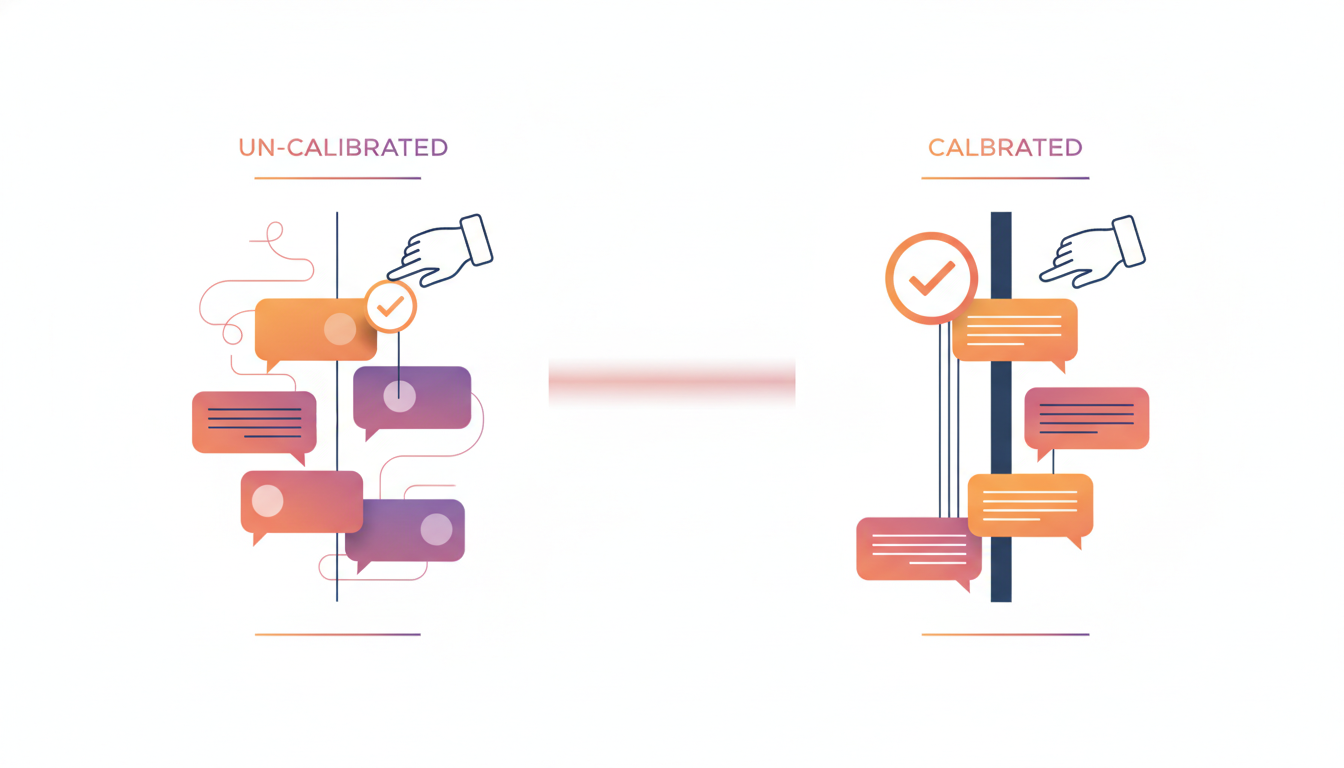
Here is how they compare in a real deployment scenario.
| Feature | Calibrated Probabilities | Uncalibrated Probabilities |
|---|---|---|
| Meaning | 80% = 80% chance of being correct | 80% = raw model score (could be anything) |
| Thresholding | Safe to cut off at 0.70 | Dangerous; arbitrary cutoffs fail |
| Risk Management | You can predict error rates | You cannot trust error estimates |
| Cost Control | Optimize for precision/recall | Often leads to over-escalation |
| Trust | Human auditors can verify stats | Requires manual spot-checking |
Using uncalibrated models often means building a safety net that doesn't hold. You end up over-escalating to humans because you don't trust the low-confidence labels. This kills efficiency.
How to Use Calibrated Probabilities in AI APIs?
You need an endpoint that returns numbers, not just text. Many LLM APIs return a generated label like "High Priority" with no confidence score. You cannot build a routing pipeline on that alone.
A decision API returns a JSON object with a probability for each class. You send a message and ask "Is this urgent?" The API returns {"urgent": 0.85}. You check the number against your internal rules.
For a definition of the architecture, see What is a decision API? It explains why a fixed protocol is better than parsing free text responses.
When you evaluate APIs, ask for calibration benchmarks. If a vendor says "accuracy is 95%," ask for the reliability curve. If they cannot provide it, they are likely giving you uncalibrated scores.
Measuring Calibration: Key Metrics for 2026
How do you know if a model is calibrated? You do not just look at accuracy. Accuracy hides confidence errors. A model can be 50% accurate but always say 100% confidence.
Expected Calibration Error (ECE): This measures the gap between predicted confidence and actual accuracy. Lower is better. A score near 0.01 is excellent. Many systems sit above 0.10 without post-processing.
Brier Score: This measures the mean squared error of probability predictions. It penalizes both wrong classes and wrong confidence levels. It is the standard for binary and multi-class tasks.
In 2026, we see a shift toward task-specific calibration. A model might be well-calibrated for intent detection but poorly calibrated for sentiment. Always check calibration on your specific domain data, not just general benchmarks.
Implementing Calibrated Decisions: A Developer's Perspective
Integration is simple if the protocol is clear. You send the text. The API returns a JSON with a float between 0 and 1. You write a rule: if prob > 0.9: auto_resolve().
The hard part is monitoring. Drift happens. The data you train on changes, and calibration shifts. You need a dashboard that tracks ECE over time. If ECE rises above 0.05, you retrain or recalibrate.
We built Laya to run this inference locally or in the cloud with zero data retention. This ensures the probabilities are consistent. You avoid the latency of chaining multiple LLMs to get a confidence score.
For migration paths, see Laya vs. TypeSafe Jev. It compares how different systems handle protocol compatibility and calibration consistency.
Beyond Accuracy: Building Trust and Transparency with Calibrated AI
Transparency is not just a policy document. It is a metric. You show stakeholders that your automation has a known error rate.
If you escalate 10% of cases to humans, you know exactly why. It is because the probability was below 0.90. You can explain this to compliance teams. They see the math. They do not see a black box.
This is critical in regulated industries. Health and finance teams need to know when a model is uncertain. They do not need a "best guess." They need a range of possibilities.
When you use calibrated probabilities, you stop guessing. You stop hoping the model is right. You build systems that account for uncertainty explicitly. That is how you scale AI without breaking operations.
FAQ
what are calibrated probabilities
Calibrated probabilities are model output scores where the value matches the actual frequency of correctness. If the model predicts 0.8, it should be right 80% of the time across many predictions.
why are calibrated probabilities important
They allow you to set fixed thresholds for automation. You can trust that a score above 0.9 truly means 90% reliability, reducing the risk of silent errors in production pipelines.
calibrated vs uncalibrated probabilities
Uncalibrated scores are raw outputs that do not reflect real-world accuracy. Calibrated scores are adjusted so their numerical value aligns with how often the model is actually correct.
how to use calibrated probabilities in AI
You use them in decision APIs to filter results. You set a minimum probability threshold to trigger actions like auto-resolving tickets or escalating high-risk documents to humans.
benefits of calibrated probabilities for decision APIs
They let you control risk and cost explicitly. You know how many errors to expect at any confidence level, making budgeting and compliance auditing predictable and auditable.
Topics
- calibrated probabilities AI
- what are calibrated probabilities
- why are calibrated probabilities important
- calibrated vs uncalibrated probabilities
- how to use calibrated probabilities in AI
- benefits of calibrated probabilities for decision APIs
- evaluating AI model confidence
- interpretable AI predictions