On this page (9 sections)
Explainable AI real-time decisions require models that output calibrated probabilities, not just labels. This transparency allows teams to audit outcomes, satisfy regulators, and debug failures without guessing. In high-stakes environments, trust is earned through visibility, not accuracy alone.
Key takeaways
- Calibrated probabilities provide measurable confidence scores that reflect true model accuracy.
- Decision APIs offer structured outputs that avoid the hallucinations of generative LLMs.
- Transparent AI reduces compliance risk in finance, healthcare, and support workflows.
What is Explainable AI (XAI) and why is it crucial for real-time decisions?
Explainable AI (XAI) refers to systems designed so humans can understand the reasoning behind their predictions. In real-time decision making, this means seeing why an input was classified as high-risk or low-priority before acting on it.
Without XAI, teams deploy models that function as black boxes. When a decision goes wrong, there is no log to trace the logic. As noted by industry analysis, the rise of explainable AI addresses the need for accountability in automated systems [https://hbr.org/2023/09/the-rise-of-explainable-ai]. For engineers building routing pipelines, this means swapping free-text generation for structured, verifiable outputs.
The limitations of 'black box' AI in critical applications

Black box models prioritize accuracy metrics over interpretability. In critical applications like fraud detection or patient triage, a wrong label can have serious consequences. If you cannot explain why a transaction was blocked, you cannot appeal the decision.
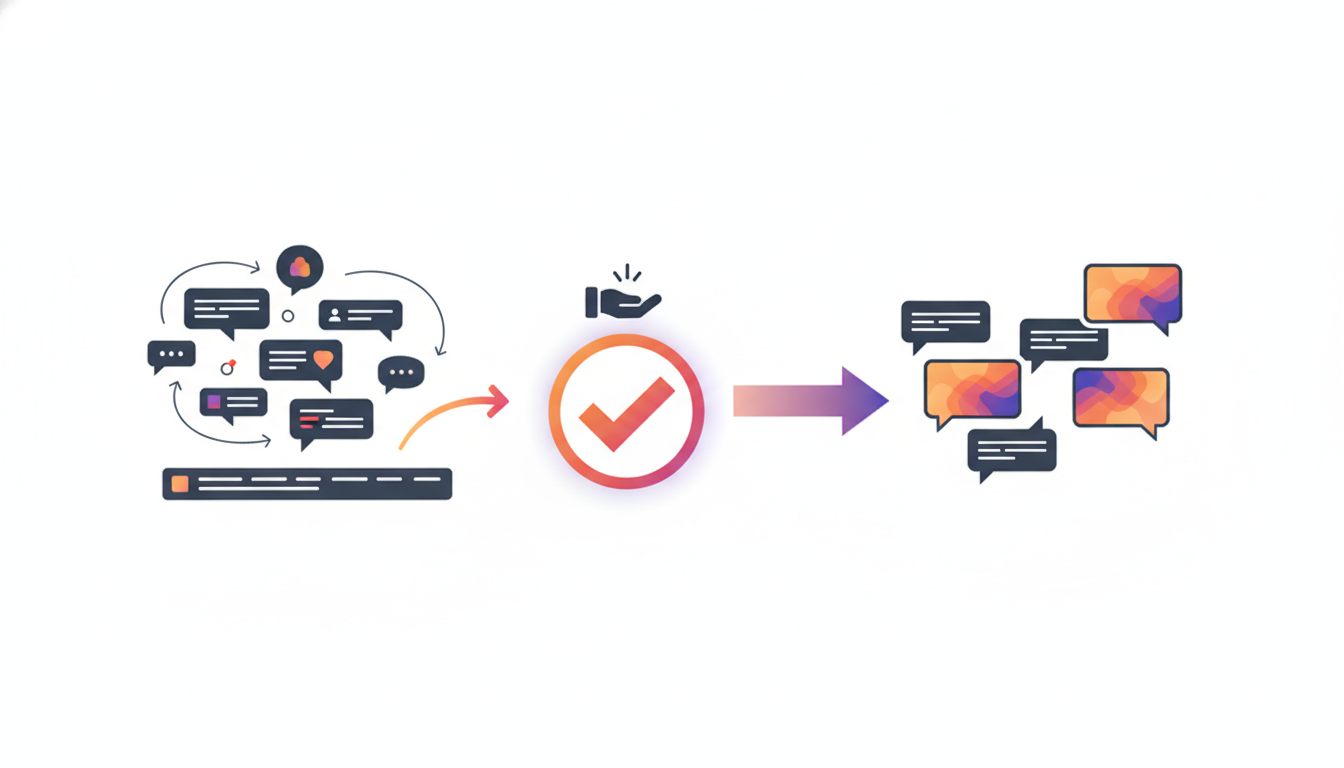
Generative LLMs exacerbate this by producing unstructured text. Parsing that text for decisions introduces latency and error. You might get a label, but you lose the signal about confidence. Real-time transparency demands that the model’s certainty is explicit, not hidden in token probabilities.
Key principles of explainable AI for classification models

To make AI explainable, the output must be structured and measurable. We recommend three principles for production systems:
- Structured Output: Use typed questions (yes/no, choice) rather than open-ended generation.
- Calibrated Scores: Return probabilities that match observed accuracy rates.
- Audit Trails: Log inputs and outputs without storing sensitive data.
| Feature | Black Box LLM | Decision API (XAI-ready) |
|---|---|---|
| Output | Unstructured text | Structured JSON |
| Confidence | Implicit / Hidden | Calibrated probability |
| Latency | High (token-by-token) | Low (parallel forward pass) |
| Auditability | Difficult to parse | Native support |
| Hallucination | Common | Minimal / None |
Adopting these principles ensures your pipeline remains debuggable. You can trace a rejection to a specific score threshold rather than a vague sentiment.
How calibrated probabilities enhance AI explainability
Calibrated probabilities are numbers that reflect how often the model is right. If a model says 80% confidence, it should be correct 80% of the time in the long run. This differs from raw logits, which are uncalibrated and misleading.
We discuss this in depth in our guide on Beyond Sentiment: The Rise of Calibrated Probabilities in AI Decision Making. When you use a calibrated score, you can set thresholds that align with business risk. A threshold of 0.95 for fraud means you only act when the model is nearly certain. This reduces false positives while keeping the logic transparent.
Implementing XAI in your decision API: practical steps
Implementing XAI starts with choosing the right interface. If you are building a classification pipeline, avoid generic chat endpoints. Instead, use a decision API designed for specific questions.
First, define your schema. What questions do you need answered? Do you need a category, a score, or a boolean flag? Next, evaluate latency. Real-time decisions often need answers under 200ms. Finally, verify data handling. Ensure the provider does not retain your input data for training. For more on infrastructure costs, read our analysis on The True Cost of AI Decision APIs in 2026.
Real-world use cases: where explainable AI makes a difference
In healthcare, explaining why a symptom was flagged is non-negotiable. Clinicians need to know if a triage model is relying on age, history, or acute signs. In finance, regulators require audit trails for every automated decision.
Forbes highlights that transparency is essential for critical decision-making, especially where human oversight is required [https://www.forbes.com/sites/forbestechcouncil/2023/10/26/the-importance-of-explainable-ai-in-critical-decision-making/]. When we routed support tickets using a decision API, we could show managers exactly which intent triggered an escalation. This reduced friction between ops and engineering. It also allowed us to refine thresholds without retraining the entire model.
Navigating regulatory landscapes with transparent AI
Regulations like GDPR and HIPAA impose strict requirements on automated processing. You must be able to explain the logic behind a decision that affects a person. Vague model descriptions do not satisfy auditors.
Transparent AI helps you meet these standards. By logging inputs and structured outputs, you create a defensible record. If you host in Switzerland, you gain additional data residency benefits. Learn more about Why Swiss-hosted AI matters for medical data to understand the compliance advantages of zero-retention architectures.
Choosing an XAI-ready decision API: what to look for
When evaluating vendors, ask for benchmark results. Do not accept vague claims about accuracy. Look for specific datasets and performance numbers. Also check protocol compatibility. If you are migrating from another system, ensure the API supports your existing schema.
We compare popular options in our Laya vs. TypeSafe Jev post. A good provider will offer clear documentation and allow you to test with your own data. Avoid vendors that hide their model architecture or refuse to share retention policies. Clarity is a feature, not a request.
FAQ
What is XAI for decision APIs?
XAI for decision APIs means providing structured outputs like calibrated probabilities instead of unstructured text. This allows engineers to audit decisions and set clear thresholds for automation.
How do I explain AI predictions to non-technical stakeholders?
Use calibrated probabilities and structured labels. Show the input and the score, then explain the business rule (e.g., "Score > 0.9 triggers escalation").
Why is real-time AI model transparency important?
Real-time transparency ensures you can act on decisions immediately while retaining the ability to review them later. It prevents blind automation in high-stakes workflows.
Can auditable AI models help with compliance?
Yes. Auditable AI models log inputs and outputs with retention policies. This creates the necessary trail for GDPR, HIPAA, or internal security reviews.
What are the best practices for transparent AI in business?
Adopt structured schemas, use calibrated probabilities, and choose vendors with zero data retention. Prioritize explainability alongside accuracy and latency.
If you are ready to move beyond black boxes, explore how a decision API can simplify your workflow. Visit Laya Studio to see benchmarks and pricing in action.
Topics
- explainable AI real-time decisions
- XAI for decision APIs
- interpretable AI classification
- auditable AI models
- transparent AI for business
- AI ethics in decision systems
- regulatory compliance AI
- how to explain AI predictions